
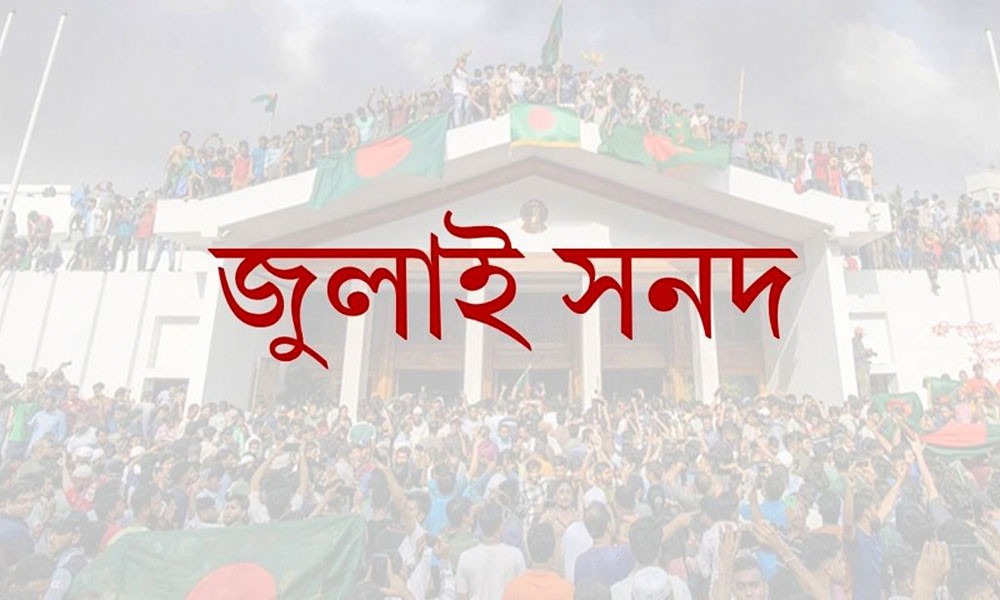
While the charter has generated significant expectations, it has also raised numerous questions and debates. The ambiguity stems not only from its contents but also from its political interpretations, implementation methodologies, and the true extent of national consensus. Consequently, a critical question has emerged: Will the July Charter genuinely reduce political division and build a foundation for broader consensus, or will its political misuse intensify new polarizations?
The July Charter was never meant to be viewed as merely another political manifesto. Instead, its importance has been highlighted as the institutional legacy of the July-August mass uprising. Formulated after a pivotal shift in Bangladesh's recent history, it aims to restructure state machinery and provide a framework for necessary governance reforms.
The charter represents a potential milestone for realizing long-standing demands for constitutional and institutional reform. Key proposals—such as ensuring the independence of the judiciary, limiting the prime minister's tenure, enhancing transparency and credibility in elections, and establishing effective checks and balances among state institutions—are undoubtedly vital issues that have long been discussed in Bangladesh's political arena.
Even a well-intentioned initiative can spark controversy due to weak political management. While the National Consensus Commission’s efforts to foster dialogue among political parties are commendable, holding discussions is not synonymous with achieving unanimous consensus. The commission engaged with 33 political parties and alliances, but notably not with all registered political parties in the country.
More importantly, the draft of the charter itself acknowledges fundamental disagreements among political parties on several core issues. Thus, while the charter remains a vital document of political understanding, it cannot be characterized as an unquestioned, all-encompassing national contract. This distinction carries immense political significance.
In ongoing political campaigns, parties like Jamaat-e-Islami and the National Citizen Party (NCP) are often presenting the July Charter as if it has already attained an unquestionable national mandate. Their rhetoric suggests that securing public support through a referendum or aligning with the charter will automatically resolve contentious constitutional matters, binding future governments to a rigid implementation structure.
Such interpretations are overly simplistic and concerning for the democratic process. While a referendum can grant political legitimacy to reform initiatives, it cannot replace prescribed constitutional amendment procedures, parliamentary scrutiny, or broader democratic deliberation. Furthermore, a referendum result cannot simply erase the underlying disagreements embedded within the charter.
Equally concerning is the growing tendency to label anyone questioning the charter’s implementation methods or specific proposals as "anti-reform" or opposed to the spirit of the July Uprising. Such political behavior risks shrinking the space for healthy democratic debate. Supporting institutional reform does not mean one must unconditionally endorse every proposal or mechanism within the charter.
A functioning democracy thrives on reasoned debate, open dialogue, and the capacity to accommodate dissenting views. Divergent opinions on specific reform methodologies do not equate to anti-reform sentiments; rather, scrutinizing proposals is a healthy and necessary aspect of a vibrant democratic process.
The fundamental strength of the July Charter lies in its potential for inclusivity. To serve as a bedrock for national unity, it must acknowledge and respect dissent rather than suppress it. Historically, documents that foster a culture of consensus rather than deepening political fault lines stand the test of time. However, current political dynamics threaten to transform this document into a new focal point of political conflict.
This raises serious questions regarding the strategy of parties like Jamaat-e-Islami and the NCP. If the charter is weaponized to solidify partisan positions rather than used as a catalyst for broader national dialogue, its core objective will be compromised. Turning every constitutional debate into a litmus test of loyalty to the July movement will not facilitate lasting institutional reform; instead, it may yield short-term political gains at the cost of long-term national division.
This responsibility, however, does not rest solely on political parties. The government must also exercise caution and refrain from portraying the charter as a reflection of unquestioned national consensus. Acknowledging existing disagreements is not a sign of weakness, but a fundamental characteristic of democratic politics.
Those who took to the streets in July 2024 envisioned accountable state institutions, free and fair elections, and a constitutional framework that guarantees a balance of power. They did not march to see a return to political stalemates, polarizations, or strategic struggles for power.
The July Charter still holds immense potential to become a historic landmark in Bangladesh’s democratic and institutional evolution. However, that potential can only be realized if political forces treat the document not as a tool for political victory, but as the starting point for a broader, inclusive national dialogue, compromise, and genuine reform.