
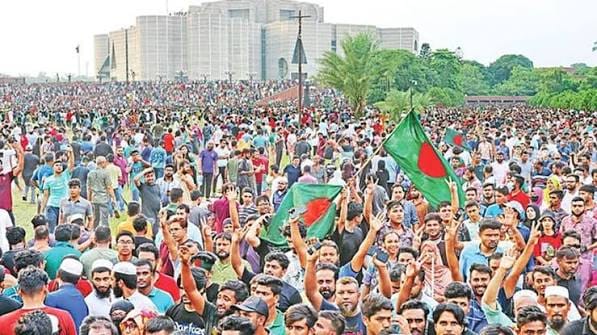
When the interim government assumed office in August 2024, its greatest challenge was not merely navigating a period of political transition, but steering the state toward a new path from a legacy of pervasive corruption, fragile institutions, and deep-seated administrative distrust. Following the July uprising, citizens expected the beginning of a fresh era marked by transparency, accountability, and a corruption-free administration.
However, ground realities reveal that the legacy administrative culture and corrupt networks have not easily dissolved. Various surveys and observations indicate that harassment and bribery continue to plague ordinary citizens seeking public services.
TIB’s 'National Household Survey 2025' offers a stark reflection of this reality. According to the report released in June 2026, citizens were forced to pay an estimated BDT 12,633.20 crore in bribes to access public services between November 2024 and October 2025—a 15.9 percent increase compared to 2023.
The survey reveals that 81.6 percent of households experienced corruption while seeking at least one public service, up from 70.9 percent in the previous survey. Simultaneously, 63.6 percent of households had to pay bribes to receive services, compared to 50.8 percent in 2023.
Despite experiencing corruption, many victims refrained from lodging complaints. According to the report, 61.3 percent of respondents felt filing a complaint was futile, believing that corruption is so deeply embedded within the administrative apparatus that grievances would yield no tangible results. TIB data indicates that the highest incidences of corruption were reported in passport services, judicial services, law enforcement agencies, and land administration.
Dr. Iftekharuzzaman, Executive Director of TIB, noted that bribery has essentially become institutionalized in many sectors. A vast majority of service seekers feel they have no alternative but to pay bribes, with the brunt of this burden falling on rural populations, low-income groups, women, and marginalized communities.
Analysts point out that the interim government’s major shortcoming lay in the fact that the expected transformation did not materialize within the administrative structure itself—the very framework promised to be reformed.
The persistence of a corrupt culture despite political change was also echoed by Mirza Fakhrul Islam Alamgir, Secretary General of the BNP and Minister for Local Government, Rural Development and Co-operatives. Reflecting on his experience in official administration, he observed that no fundamental shift has occurred in the administrative machinery, noting that those accustomed to irregularities continue to find loopholes. His remarks have reignited debate over whether a change in government automatically transforms state culture or if old structures simply adapt to new realities.
Experts note that while any incoming government inherits an existing bureaucracy, its success or failure depends on how effectively it can reform that framework.
High expectations were also pinned on student representatives who emerged from the leadership of the July movement, as they pledged a new form of accountable politics outside traditional party lines. However, their tenure was not immune to controversy.
TIB’s Executive Director commented that student advisers fell short of meeting public expectations. Controversies, allegations of corruption, nepotism, and conflicts of interest surfaced surrounding various ministries under their stewardship.
Former Adviser Asif Mahmud Shojib Bhuyain faced various media reports alleging irregularities during his tenure, with questions raised regarding project allocations, recruitment processes, and administrative decisions—claims he consistently denied while offering explanations. Meanwhile, former Information Adviser Mahfuz Alam faced criticism over the slow pace of implementing the Media Reform Commission's recommendations. Commission stakeholders expressed disappointment over the non-implementation of key proposals, including the Journalist Protection Act.
Political analyst Altaf Parvez believes that the structural transformation envisioned after the mass uprising was not fully realized. In his view, student representatives often remained confined to conventional administrative roles rather than acting as transformative reformers. Analysts suggest that while the July movement created new political expectations, subsequent controversies regarding appointments, administrative influence, and the exercise of power significantly weakened that momentum.
Proponents of the interim administration, however, argue that they inherited a state apparatus where corruption was deeply rooted over decades, making a complete overhaul in a short period exceptionally difficult. Nonetheless, critics argue that the gap between public expectations and ground realities remains the primary metric for evaluating the government's legacy.
This scenario poses a formidable challenge for the present government as well, which must now navigate an administrative system where long-standing practices of irregularity are hard to break and public trust remains difficult to rebuild.
In this context, experts emphasize the urgent implementation of TIB's recommendations, which include digitizing public services, establishing effective grievance redress mechanisms, mandating wealth disclosures for officials, adopting comprehensive anti-corruption policies, and strictly enforcing the rule of law.
Analysts conclude that the paramount lesson of July is that while political change can be achieved swiftly, institutional transformation demands a far more complex struggle. Failing to convert the momentum of a mass movement into sustainable reforms risks repeatedly eroding public confidence. Ultimately, history will judge the interim government not merely by its declared ambitions, but by how effectively it utilized the window of opportunity it was granted. The responsibility now rests on the current administration to translate political change into genuine administrative and institutional reform—lest public faith in the state itself be permanently compromised.